Start with the job: install and test Context7 MCP against a documentation task
Context7 MCP can reduce stale-library context by retrieving project documentation on demand, but retrieved text remains external input. Evaluate it on a named library, version and question instead of assuming every returned passage is current or authoritative.
The Context7 repository states that library projects can be community-contributed and cannot all be guaranteed for accuracy or security. Use the original vendor documentation for consequential or version-sensitive claims.
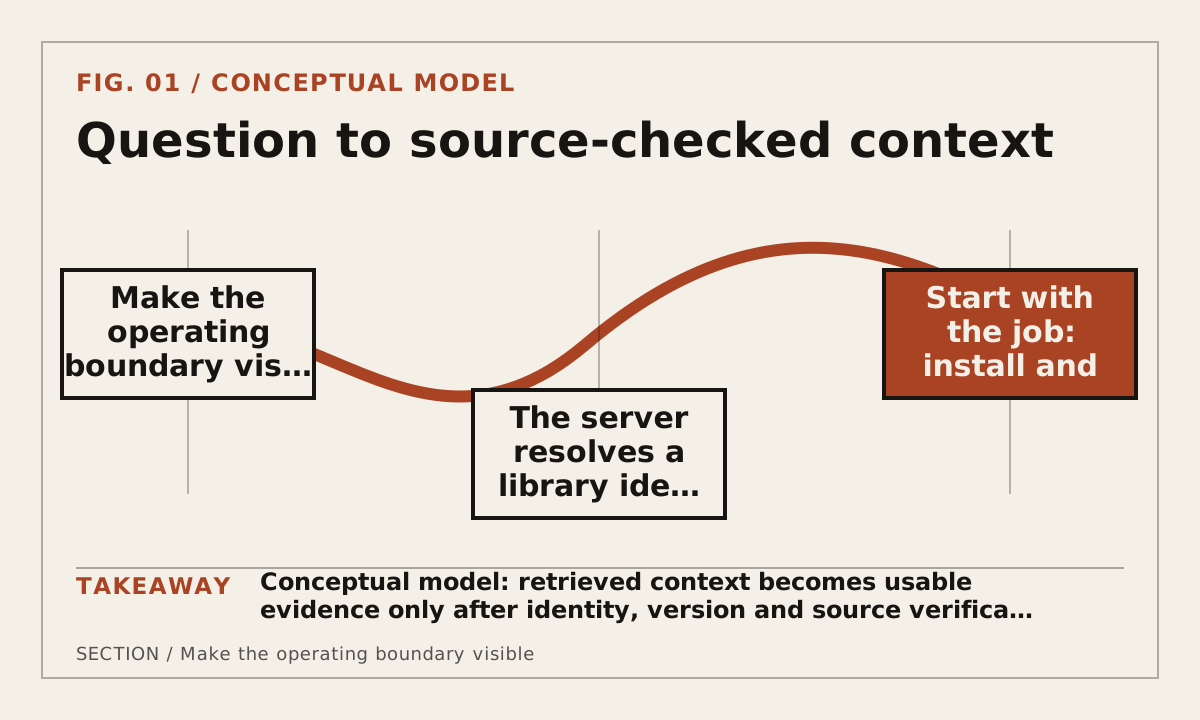
Make the operating boundary visible
The server resolves a library identity and returns documentation context through MCP tools. The useful evidence is therefore the resolved project, the requested topic and whether the passage can be traced to the library's current official material.
Question to source-checked context
Build a reproducible path
For Context7 MCP: Documentation Context Under Test, use a small fixture that another developer can repeat without privileged production data. Change one boundary at a time and preserve the exact configuration needed to explain how the page's decision was reached.
- Choose a library version and a question with a known official answer.
- Configure the maintained remote endpoint or package without exposing the API key.
- Inspect the server tools and record the resolved library identity.
- Compare the returned guidance with the library's official versioned documentation.
Keep secrets outside the context7 mcp artifact. Record variable names, scopes and owners, then verify the relevant system of record whenever this tool or workflow can change external state.
Record evidence that survives a rerun
A useful test fixture contains the exact question, library, version, returned source references and discrepancies. Fluency or answer length is not a quality measure for documentation retrieval.
- Context7 server endpoint or package release
- Resolved library and requested version
- Returned source identifiers or links
- Agreement, omission and conflict with official documentation
Date the Context7 MCP: Documentation Context Under Test record and keep factual observations separate from inference. If a claim depends on a hosted service, preview feature or moving SDK, name that dependency beside the claim.
Use a decision rule and a stopping rule
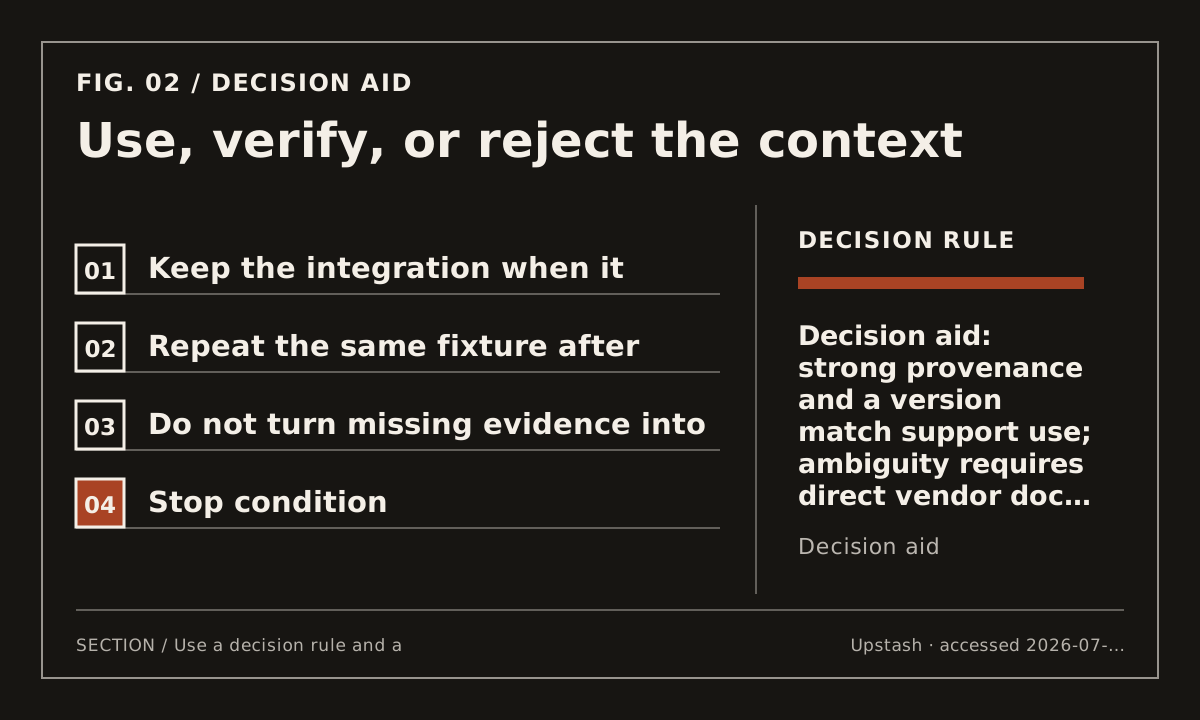
Keep the integration when it consistently resolves the intended project and makes source checking faster. Treat it as discovery rather than authority when provenance is incomplete or the target library changes rapidly.
Repeat the same fixture after reconnecting, test an ambiguous library name and ask for a feature introduced in a known version. Record uncertainty instead of converting a plausible passage into a product fact.
Use, verify, or reject the context
Protect against predictable failure and continue deliberately
For Context7 MCP: Documentation Context Under Test, the architecture review flags three recurring failure modes: specification versions are mixed; local and remote trust boundaries are conflated; a server is recommended without permission review. Treat them as release checks, not footnotes. This page remains draft when its exact implementation or intent evidence is still research-gated.
Use the MCP server evaluation guide next: it shows how to screen ownership, capabilities and access before connection.
Use the Jira MCP permission guide next: it maps Atlassian permission groups to a bounded project workflow.
Use the GitHub MCP lab note next: it applies the server review to repository permissions and toolsets.
Use the MCP field guide next: it reconnects the decision to protocol roles and versioned boundaries.