Start with the job: find and evaluate MCP servers for a concrete integration
An MCP server should be selected as an executable dependency with access to real systems. Start from one required job, then prefer the smallest maintained capability surface that can complete it under a credential you are willing to issue.
A registry entry proves discoverability, not safety, compatibility or ongoing maintenance. Installation instructions also do not prove that the advertised tools match what the server exposes at runtime.
Keep this page's decision boundary canonical
Evaluate candidates symmetrically: the same job, credential class, transport checks and denied paths. This page owns the server-selection method rather than a permanent ranking, because repositories, endpoints and maintenance status can change. Individual server pages can then document GitHub, Claude, Context7 or other product-specific behavior without turning those observations into a universal endorsement. The result is a shortlist that remains tied to an integration job and a dated evidence record.
A server review should begin with capability deltas. Compare the documented surface with what the connected server advertises, then mark any extra tool, resource or prompt as unresolved until its purpose and permission are understood. This catches a common operational change: an update can add a new write path without changing the integration job that originally justified the connection. Reapproval should therefore follow capability and credential changes, not an arbitrary calendar alone.
Remote and local servers also need different ownership evidence. For a remote endpoint, record service identity, authentication, availability and incident contacts. For a local package or container, record supply-chain origin, pinned artifact and process privileges on the host. Both cases need a removal path. The evaluation is complete only when the team can disable the server, revoke credentials and identify which workflows lose the capability without searching through individual chat histories.
Make the operating boundary visible
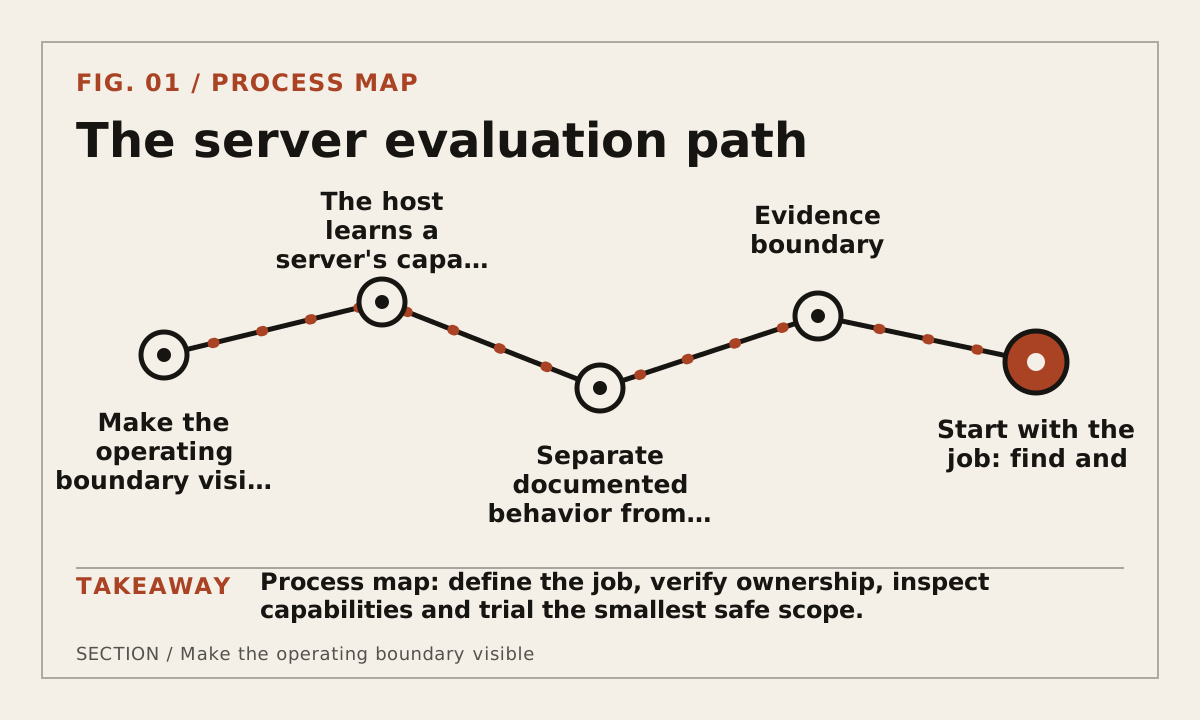
The host learns a server's capabilities during initialization and subsequent list operations. That runtime inventory must be reconciled with repository ownership, release history, transport, authentication and side effects before the connection becomes persistent.
The server evaluation path
Build a reproducible path
For MCP Servers: Choose, Verify, and Connect, use a small fixture that another developer can repeat without privileged production data. Change one boundary at a time and preserve the exact configuration needed to explain how the page's decision was reached.
- Define the single integration job before opening a directory.
- Verify publisher ownership, current release instructions and the expected transport.
- Connect with disposable or read-only credentials and inspect the advertised primitives.
- Run expected, denied, malformed and revocation cases before approving the server.
Keep secrets outside the mcp servers artifact. Record variable names, scopes and owners, then verify the relevant system of record whenever this tool or workflow can change external state.
Record evidence that survives a rerun
Record evidence that can be rechecked after an update. Screenshots of a successful conversation are weak evidence because they omit the capability schema, credential scope and denied paths.
- Repository or official service owner
- Pinned package, image digest or remote endpoint
- Tool, resource and prompt inventory
- Requested secrets, network destinations and state-changing actions
Date the MCP Servers: Choose, Verify, and Connect record and keep factual observations separate from inference. If a claim depends on a hosted service, preview feature or moving SDK, name that dependency beside the claim.
Use a decision rule and a stopping rule
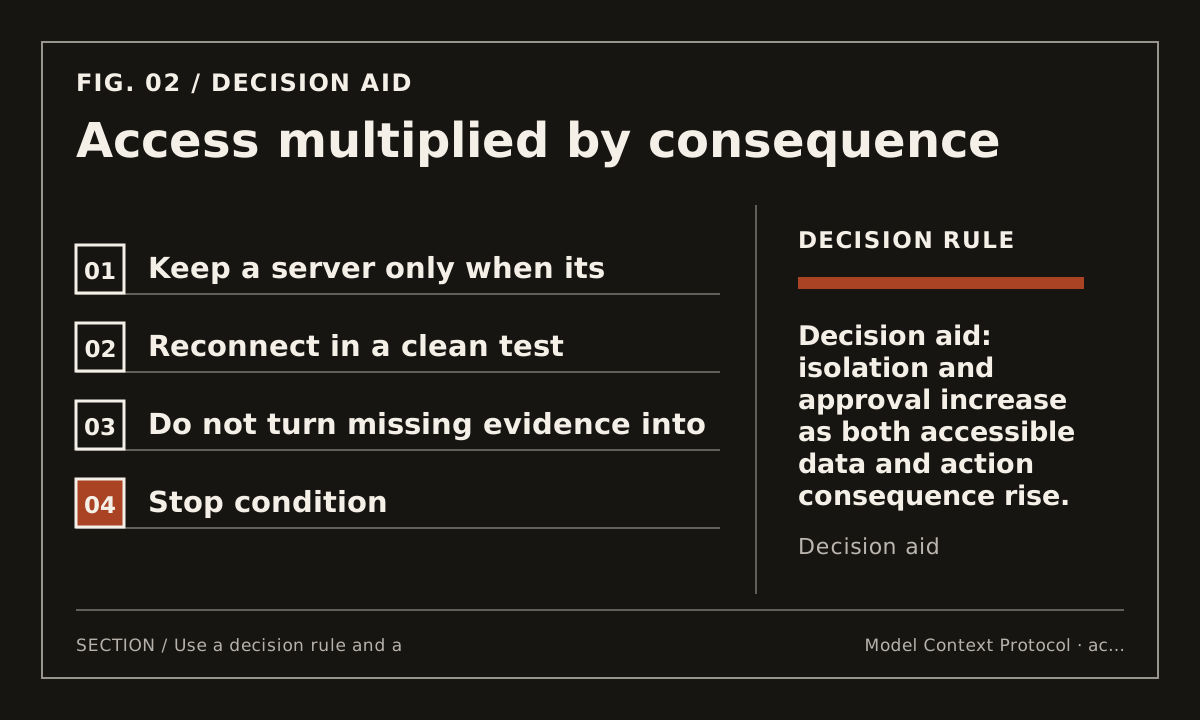
Keep a server only when its active capability surface remains proportional to the job and someone owns revalidation. A broader server is not automatically more useful; unused write tools increase review and incident scope.
Reconnect in a clean test account, compare advertised schemas with the approval record and inspect the system of record after every state-changing test. Remove the connection and rotate the trial credential when the evaluation ends.
Access multiplied by consequence
Protect against predictable failure and continue deliberately
For MCP Servers: Choose, Verify, and Connect, the architecture review flags three recurring failure modes: specification versions are mixed; local and remote trust boundaries are conflated; a server is recommended without permission review. Treat them as release checks, not footnotes. This page remains draft when its exact implementation or intent evidence is still research-gated.
Use the MCP field guide next: it reconnects the decision to protocol roles and versioned boundaries.
Use the GitHub MCP lab note next: it applies the server review to repository permissions and toolsets.
Use the Claude MCP setup guide next: it places a server at the correct Claude Code configuration scope.
Use the MCP server build path next: it turns one capability into a versioned, inspectable implementation.