Start with the job: build and test a minimal MCP server
The first useful MCP server is deliberately small: one defined client, one transport and one capability whose input, output and side effects can be reviewed. Protocol breadth should follow verified need rather than precede it.
Do not begin by wrapping an entire internal API. That makes authentication, error mapping and permission review inseparable from dozens of endpoints before the protocol loop is known to work.
Keep this page's decision boundary canonical
Stay language-neutral until the capability contract is stable. This cluster defines the server boundary, reproducible artifact and verification path; the TypeScript and Python notes own release-specific SDK instructions. That separation matters because protocol reasoning changes more slowly than package APIs. A reader should be able to review schema, side effects and lifecycle here before choosing a runtime, and later replace the implementation without changing the user-facing capability decision.
Design output limits before implementing the happy path. A resource or tool that can return an unbounded repository, table or document collection creates cost, privacy and context risks even when it is read-only. Define pagination, truncation, filtering and a clear continuation mechanism at the capability boundary. Errors should distinguish invalid input, denied access, unavailable dependencies and bounded-output conditions without copying upstream secrets or stack traces into model-visible content.
Lifecycle is part of the contract as well. Local servers need predictable startup, shutdown and logging that never corrupts stdio messages; remote servers need health, timeout and retry behavior that does not repeat state-changing calls. Record whether operations are idempotent and assign request identifiers where a retry could duplicate work. These details determine whether a minimal demonstration can become an operated server, so they belong in the build review before more tools expand the failure surface.
Make the operating boundary visible
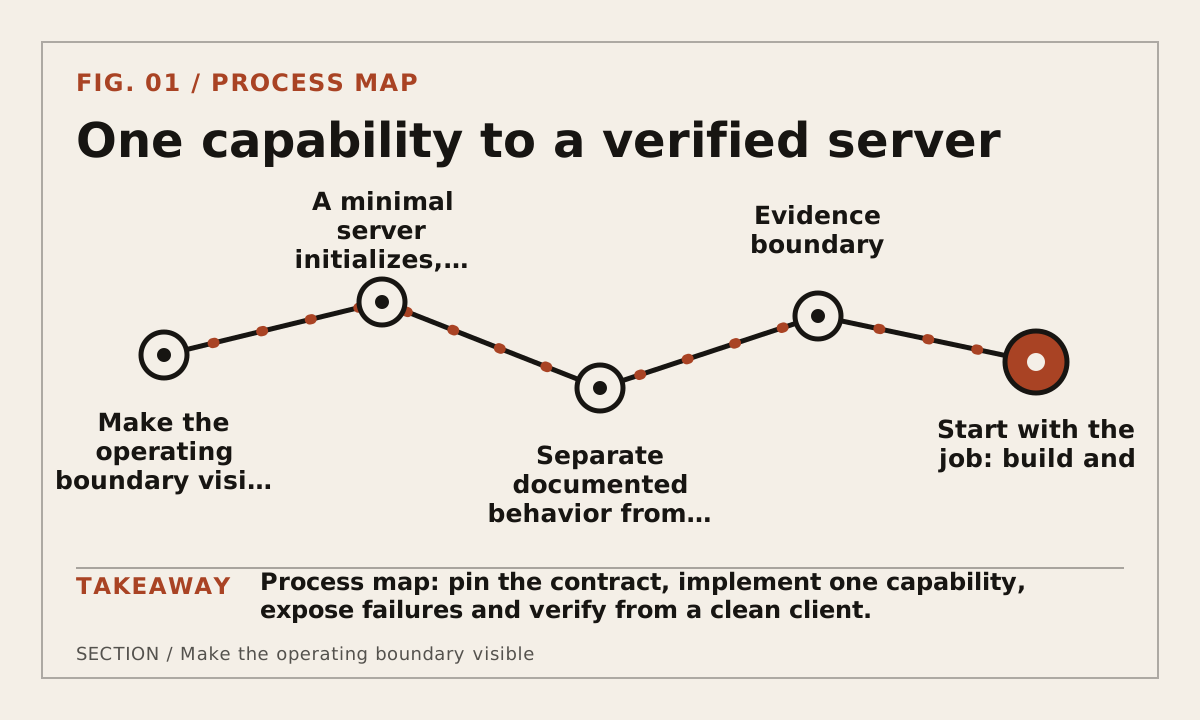
A minimal server initializes, declares supported capabilities, exposes a schema and returns protocol-compliant results or errors. The business operation remains behind that adapter, where it can keep its existing authorization and audit controls.
One capability to a verified server
Build a reproducible path
For Build an MCP Server: A Reproducible Path, use a small fixture that another developer can repeat without privileged production data. Change one boundary at a time and preserve the exact configuration needed to explain how the page's decision was reached.
- Pin a specification date and an official SDK release.
- Implement one read-only capability with a narrow schema and bounded output.
- Add explicit invalid-input, unavailable-dependency and denied-access behavior.
- Inspect the server from a clean client before adding a second capability.
Keep secrets outside the build mcp server artifact. Record variable names, scopes and owners, then verify the relevant system of record whenever this tool or workflow can change external state.
Record evidence that survives a rerun
The reproducible artifact is more than source code. Capture the launch command without secrets, negotiated version, declared schema, one sanitized request and response, and the expected error for a denied call.
- Runtime and SDK version
- Transport and lifecycle owner
- Input and output schema
- Side effects, upstream credentials and error mapping
Date the Build an MCP Server: A Reproducible Path record and keep factual observations separate from inference. If a claim depends on a hosted service, preview feature or moving SDK, name that dependency beside the claim.
Use a decision rule and a stopping rule
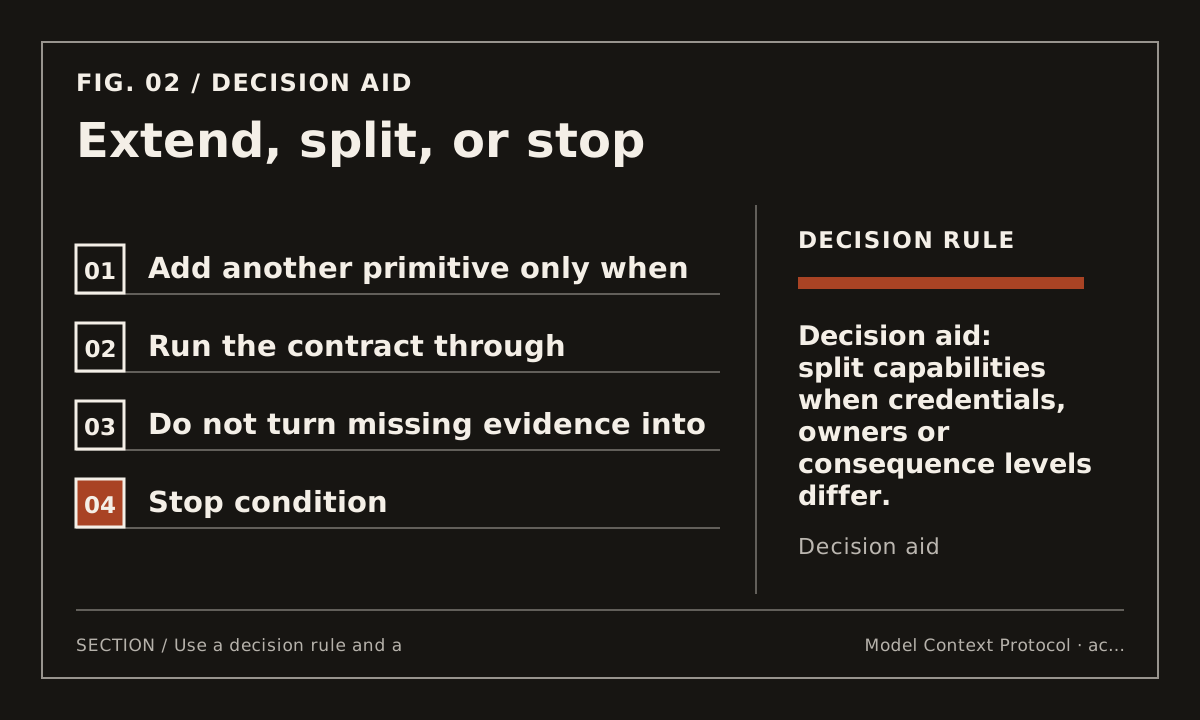
Add another primitive only when it represents a separate reader job and can retain an equally clear permission boundary. Split servers when capabilities need different credentials, owners or deployment trust zones.
Run the contract through Inspector or another known client, restart the process to test lifecycle behavior and compare the underlying system before and after calls. A tool response that says success is not proof that the intended state changed.
Extend, split, or stop
Protect against predictable failure and continue deliberately
For Build an MCP Server: A Reproducible Path, the architecture review flags three recurring failure modes: specification versions are mixed; local and remote trust boundaries are conflated; a server is recommended without permission review. Treat them as release checks, not footnotes. This page remains draft when its exact implementation or intent evidence is still research-gated.
Use the MCP field guide next: it reconnects the decision to protocol roles and versioned boundaries.
Use the TypeScript MCP implementation next: it uses the official SDK around one typed capability.
Use the Python MCP implementation next: it keeps protocol adaptation separate from testable domain logic.
Use the MCP architecture map next: it separates host policy, client state, server behavior and transport.