Start with the job: decide whether an agent platform fits the operating model
An agent platform bundles runtime decisions that a library leaves to the team. Evaluate the bundle against how your system stores state, grants tools, handles human intervention and operates across environments.
A polished builder or trace view is not proof that the platform fits production controls. Verify data handling, export paths, identity, network boundaries and what happens when the hosted control plane is unavailable.
Keep this page's decision boundary canonical
Separate a managed platform from the libraries it may expose. This cluster owns the operating-model decision—hosting, identity, persistence, traces, export and provider boundary—while the open-source shortlist and decision matrix own candidate filtering. That distinction prevents a hosted dashboard from being scored as if it were a local runtime and forces convenience claims to include the responsibilities and data boundaries the team is accepting.
Identity should be evaluated across control plane and data plane. Determine who may create an agent, register a tool, view traces, replay a run and deploy changes, then determine which runtime identity reaches external systems. A single workspace role is rarely sufficient evidence. The platform must fit existing separation of duties, and service credentials should remain scoped to the deployed workflow instead of inheriting a developer's broad access.
Portability is a concrete exercise, not a checkbox. Export a representative trace, dataset, prompt configuration and persisted state; document which parts can be reconstructed with public formats and which depend on provider-managed identifiers or services. Then estimate the operational work needed to keep the workflow running without the platform. A managed boundary can still be the correct decision, but the exit cost and degraded mode should be understood before production data and recovery procedures accumulate inside it.
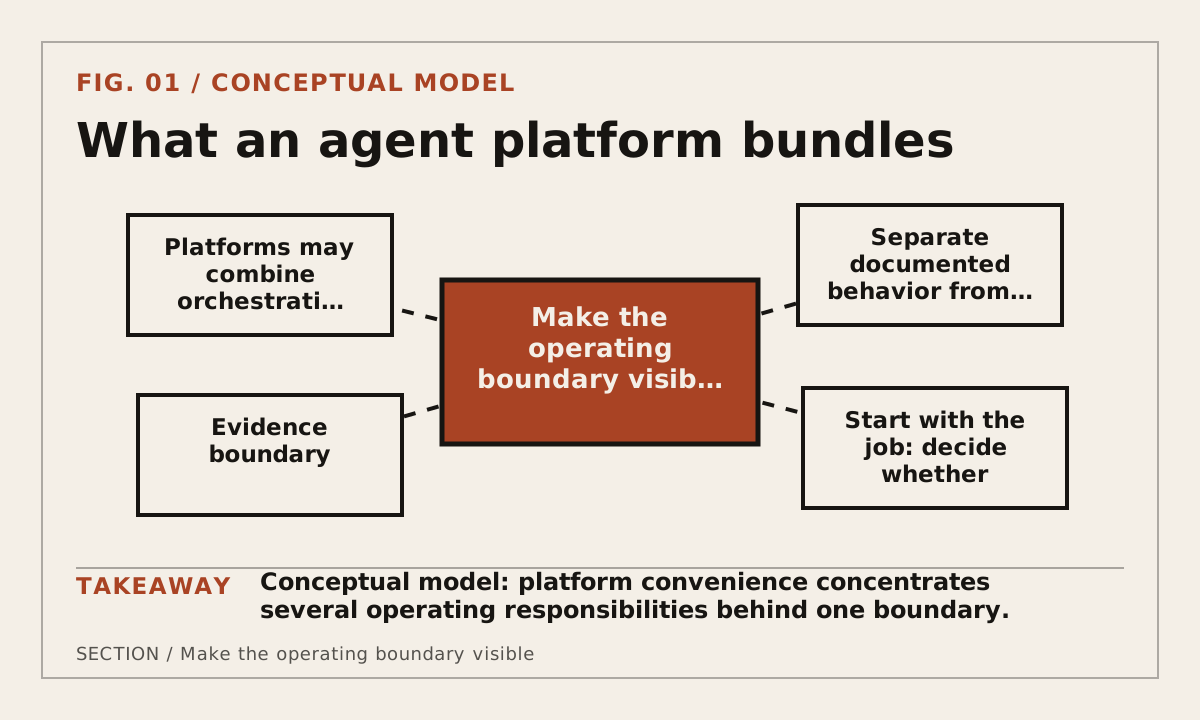
Make the operating boundary visible
Platforms may combine orchestration, model access, tool registries, persistence, tracing, evaluation and deployment. Integration reduces setup, but it also concentrates upgrade, retention and portability decisions in one provider boundary.
What an agent platform bundles
Build a reproducible path
For AI Agent Platforms: Build, Observe, or Buy, use a small fixture that another developer can repeat without privileged production data. Change one boundary at a time and preserve the exact configuration needed to explain how the page's decision was reached.
- Write the required runtime and compliance boundaries before trials.
- Separate managed platform features from open-source client libraries.
- Run one matched workflow with a tool, persisted state and intervention.
- Test export, outage, rollback and ownership of traces and credentials.
Keep secrets outside the ai agent platforms artifact. Record variable names, scopes and owners, then verify the relevant system of record whenever this tool or workflow can change external state.
Record evidence that survives a rerun
Keep a capability ledger tied to official documentation and a behavior ledger tied to the matched fixture. Pricing, quotas and preview status need dates because platform terms change independently of code.
- Hosting and data-residency boundary
- Identity, secrets and tool authorization
- State, trace and dataset exportability
- Availability, quotas, cost unit and upgrade policy
Date the AI Agent Platforms: Build, Observe, or Buy record and keep factual observations separate from inference. If a claim depends on a hosted service, preview feature or moving SDK, name that dependency beside the claim.
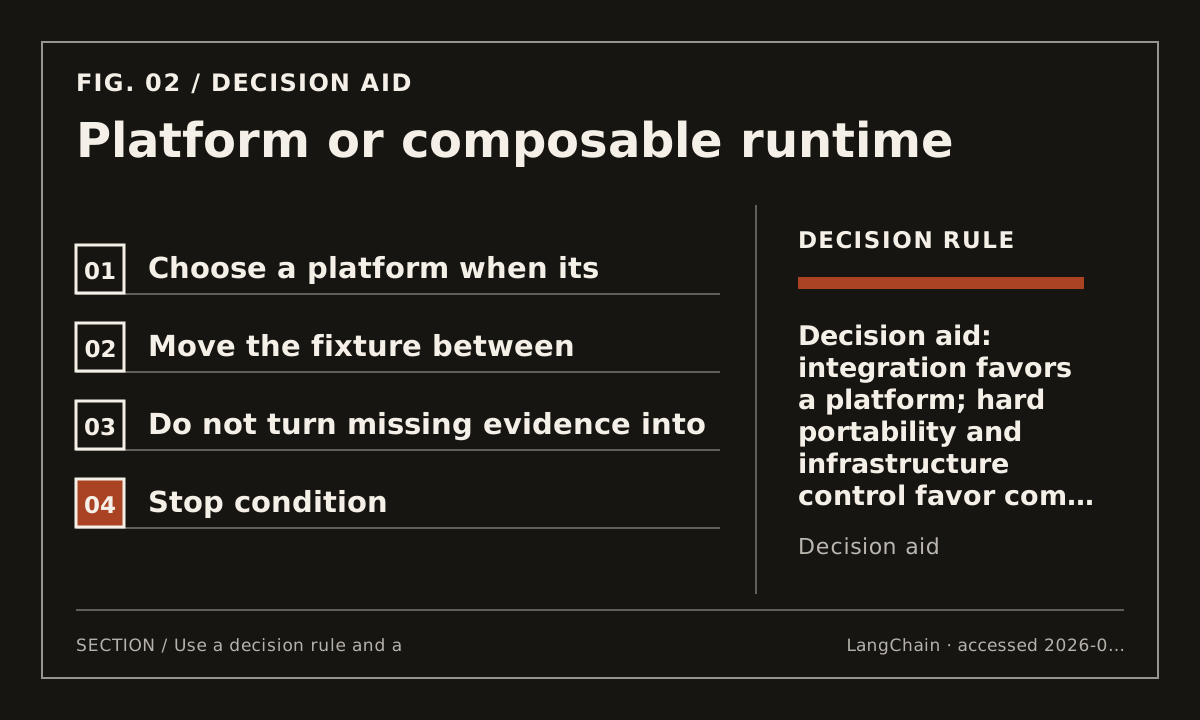
Use a decision rule and a stopping rule
Choose a platform when its integrated controls remove work the team would otherwise own and its boundaries are acceptable. Prefer composable libraries when export, custom infrastructure or provider independence is a hard requirement.
Move the fixture between development and a production-like environment, inspect trace redaction and export the run data. Simulate loss of the platform service to establish which application functions remain available.
Platform or composable runtime
Protect against predictable failure and continue deliberately
For AI Agent Platforms: Build, Observe, or Buy, the architecture review flags three recurring failure modes: the page becomes a vendor listicle; frameworks are compared on different tasks; deployment and observability costs are ignored. Treat them as release checks, not footnotes. This page remains draft when its exact implementation or intent evidence is still research-gated.
Use the AI agent framework field guide next: it starts selection from a fixed production job and hard requirements.
Use the open-source framework shortlist next: it filters projects through license, maintenance and reproduction evidence.
Use the framework decision matrix next: it turns requirements and confidence into an auditable score.
Use the agent pattern map next: it chooses control flow before framework-specific abstractions.