Start with the job: choose a multi-agent coordination pattern without needless complexity
Multi-agent architecture is justified when separate contexts, permissions or concurrent work create value a single agent cannot achieve cleanly. More personas alone add handoffs without adding capability.
Every additional agent creates questions about shared state, message contracts, termination, duplicated side effects and accountability. These costs should be measured against a single-agent baseline.
Make the operating boundary visible
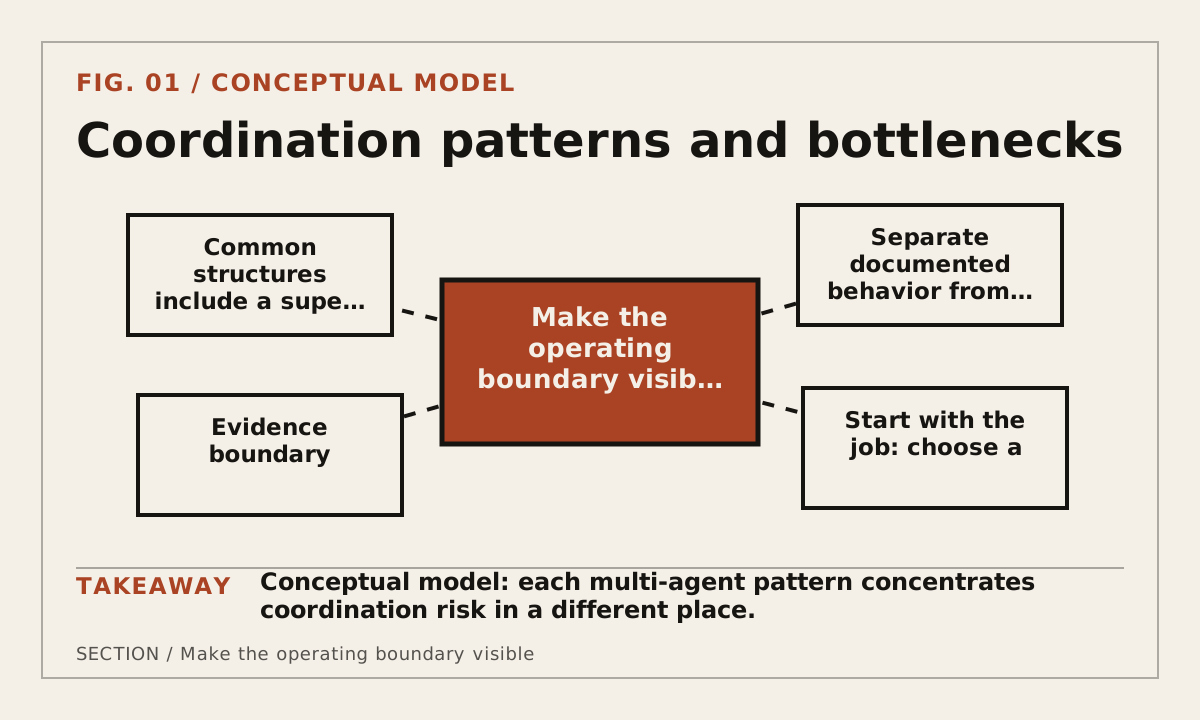
Common structures include a supervisor delegating to specialists, a router selecting one actor, peers sharing a bounded workspace and parallel workers whose results are aggregated. Each structure moves the coordination bottleneck to a different component.
Coordination patterns and bottlenecks
Build a reproducible path
For Multi-Agent Patterns: Supervisor, Handoff, and Debate, use a small fixture that another developer can repeat without privileged production data. Change one boundary at a time and preserve the exact configuration needed to explain how the page's decision was reached.
- Implement and measure the simplest single-agent baseline.
- Name the exact separation or parallelism benefit required.
- Define typed handoffs, state ownership and termination before adding actors.
- Test lost messages, duplicate work, disagreement and partial failure.
Keep secrets outside the multi agent patterns artifact. Record variable names, scopes and owners, then verify the relevant system of record whenever this tool or workflow can change external state.
Record evidence that survives a rerun
Trace the complete task across agents with correlation identifiers and explicit state transitions. A polished final answer can hide repeated tool calls, circular delegation or one specialist's unreviewed failure.
- Role boundary and unique capability
- Shared versus private context
- Handoff schema and state owner
- Termination, retry, aggregation and side-effect control
Date the Multi-Agent Patterns: Supervisor, Handoff, and Debate record and keep factual observations separate from inference. If a claim depends on a hosted service, preview feature or moving SDK, name that dependency beside the claim.
Use a decision rule and a stopping rule
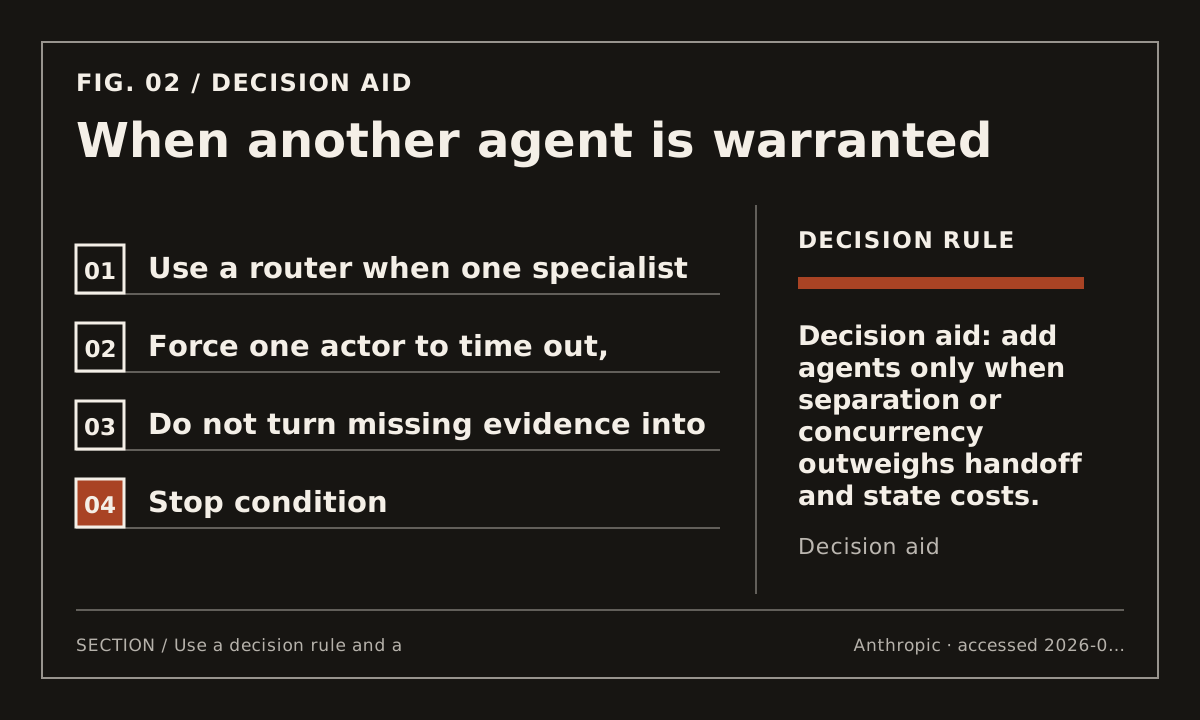
Use a router when one specialist should own the task, a supervisor when delegation needs central policy, and parallel workers only for independent units with deterministic aggregation. Keep one agent when the same context and tools are required throughout.
Force one actor to time out, return malformed output and attempt a duplicate write. The coordinator must preserve task state, prevent repeated consequences and end with an attributable status.
When another agent is warranted
Protect against predictable failure and continue deliberately
For Multi-Agent Patterns: Supervisor, Handoff, and Debate, the architecture review flags three recurring failure modes: the page becomes a vendor listicle; frameworks are compared on different tasks; deployment and observability costs are ignored. Treat them as release checks, not footnotes. This page remains draft when its exact implementation or intent evidence is still research-gated.
Use the agent pattern map next: it chooses control flow before framework-specific abstractions.
Use the human-in-the-loop pattern next: it places durable review before consequential actions.
Use the AI agent framework field guide next: it starts selection from a fixed production job and hard requirements.