Start with the job: score frameworks against state, tools, deployment, and observability
A framework decision matrix is useful only after the team defines what can disqualify a candidate. Hard gates prevent a high convenience score from compensating for an unacceptable security, deployment or state boundary.
Scores are decision aids, not measurements of universal quality. Weights must reflect one production job, and every score needs a dated source or matched test rather than intuition.
Keep this page's decision boundary canonical
Write scoring anchors before seeing vendor results. For example, a state-recovery criterion can define zero as no persistence, one as manual application recovery, and higher anchors as demonstrated checkpoint and resume under the team's deployment boundary. The exact scale matters less than observable distinctions. Anchors prevent reviewers from translating familiarity or attractive documentation into higher scores and make later rescoring possible without reconstructing the original conversation.
Handle unknowns explicitly. An undocumented feature is unknown, not absent; an untested claim is not equivalent to a demonstrated capability. Track both score and confidence, and block a decision when a hard-gate fact remains unknown. For weighted criteria, show how low-confidence evidence changes the ranking under a conservative assumption. This keeps an incomplete candidate from winning because blanks were treated as neutral values.
Finally, preserve vetoes outside the total. Security, license, data residency or preview stability may be unacceptable regardless of a candidate's strengths elsewhere. A visible disqualification reason is more honest than setting an enormous weight that obscures the rule. Revisit the matrix when the production job, evidence version or hard gate changes; do not continuously tweak weights merely to preserve a preferred winner.
Make the operating boundary visible
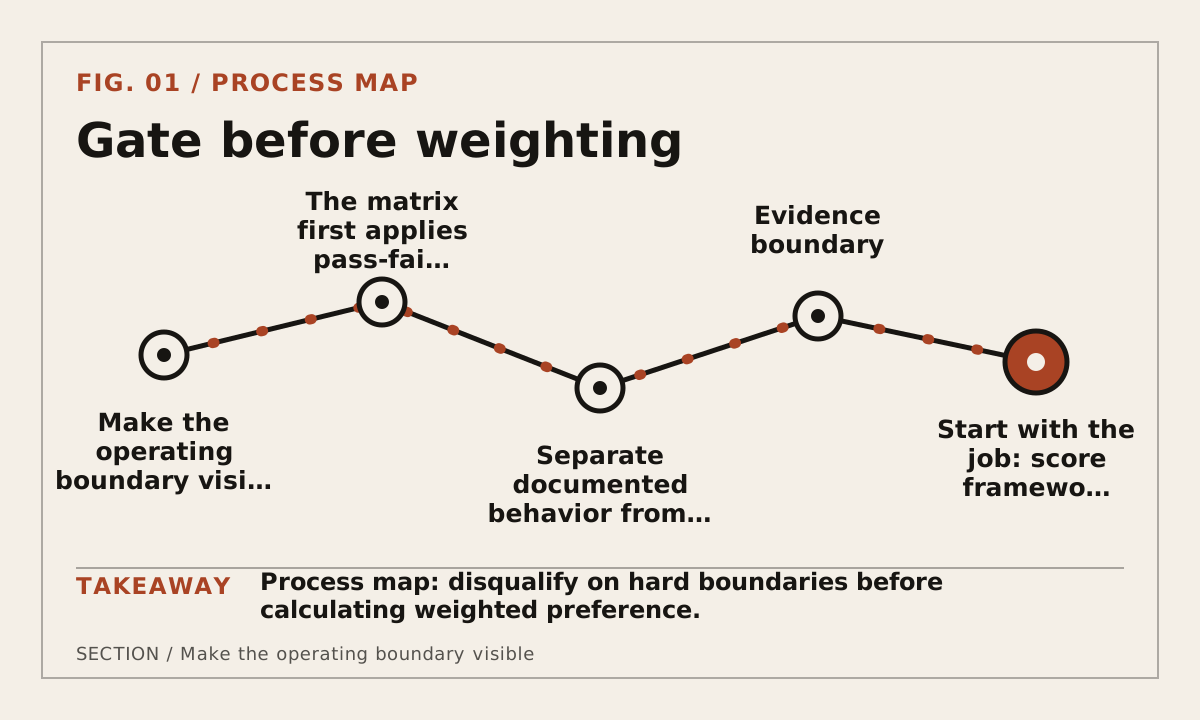
The matrix first applies pass-fail gates, then weights differentiating criteria among survivors. Confidence and evidence freshness sit beside each score so missing proof remains visible instead of becoming a neutral midpoint.
Gate before weighting
Build a reproducible path
For AI Agent Framework Decision Matrix, use a small fixture that another developer can repeat without privileged production data. Change one boundary at a time and preserve the exact configuration needed to explain how the page's decision was reached.
- Write five or fewer hard gates from the system boundary.
- Define observable scoring anchors for each weighted criterion.
- Attach official documentation or fixture evidence to every cell.
- Run sensitivity checks by changing weights and confidence assumptions.
Keep secrets outside the ai agent framework comparison artifact. Record variable names, scopes and owners, then verify the relevant system of record whenever this tool or workflow can change external state.
Record evidence that survives a rerun
Keep raw observations separate from calculated totals. A score of four should correspond to a named behavior, such as resumable state demonstrated under interruption, not a vague impression of maturity.
- Criterion definition and disqualifying threshold
- Weight, rationale and decision owner
- Observed evidence, version and access date
- Confidence, unknowns and sensitivity result
Date the AI Agent Framework Decision Matrix record and keep factual observations separate from inference. If a claim depends on a hosted service, preview feature or moving SDK, name that dependency beside the claim.
Use a decision rule and a stopping rule
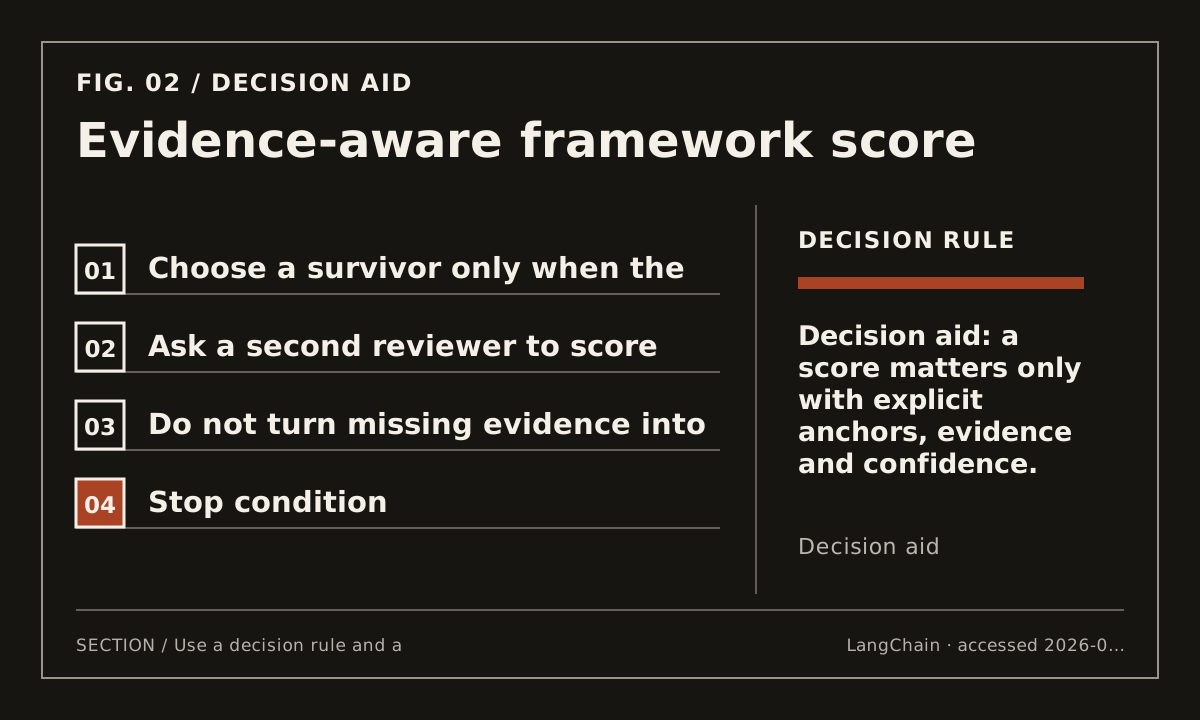
Choose a survivor only when the result remains stable under plausible weight changes and its weak areas have explicit mitigation owners. A narrow score lead is not meaningful when evidence confidence differs.
Ask a second reviewer to score the same evidence without seeing the first total, then reconcile disagreements at the criterion definition. Re-run the matrix when a material framework release or operating requirement changes.
Evidence-aware framework score
Protect against predictable failure and continue deliberately
For AI Agent Framework Decision Matrix, the architecture review flags three recurring failure modes: the page becomes a vendor listicle; frameworks are compared on different tasks; deployment and observability costs are ignored. Treat them as release checks, not footnotes. This page remains draft when its exact implementation or intent evidence is still research-gated.
Use the agent platform guide next: it examines managed state, identity, deployment and data boundaries.
Use the open-source framework shortlist next: it filters projects through license, maintenance and reproduction evidence.
Use the AI agent framework field guide next: it starts selection from a fixed production job and hard requirements.