Start with the job: choose an agent architecture pattern for the task
Agent patterns are control-flow choices, not job titles for prompts. Begin with the simplest loop that can complete the task, then add routing, parallelism, delegation or human intervention only for a documented failure or requirement.
Calling several model instances agents does not create useful specialization. Every extra actor introduces state transfer, termination and failure-propagation decisions that a single tool-using loop may avoid.
Keep this page's decision boundary canonical
Choose structure before choosing a framework abstraction. This cluster owns the transition from deterministic workflow to tool-using agent, multi-agent coordination and human intervention. The supporting pages then test the two complexity points most likely to fail: cross-agent handoffs and durable approval. A pattern belongs only when its state owner, termination rule and recovery path can be explained without relying on a vendor-specific diagram.
Model deterministic work explicitly before assigning discretion. Parsing, validation, authorization, retries and fixed business rules should normally remain code paths around the model rather than instructions the agent may reinterpret. The pattern diagram should show those gates separately from model decisions. This reduces the behavior that evaluation must infer and makes failures attributable: a schema rejection is different from a poor routing choice, even if both prevent task completion.
State granularity is another pattern decision. Shared transcripts are convenient but can leak irrelevant or sensitive context across roles; structured state requires design but makes ownership and updates visible. Choose what each step may read and write, how conflicts resolve and when old observations expire. For recurring workflows, include compaction or archival rules so the pattern does not treat an ever-growing conversation as durable memory. These controls often matter more than the number of agents shown in the architecture.
Make the operating boundary visible
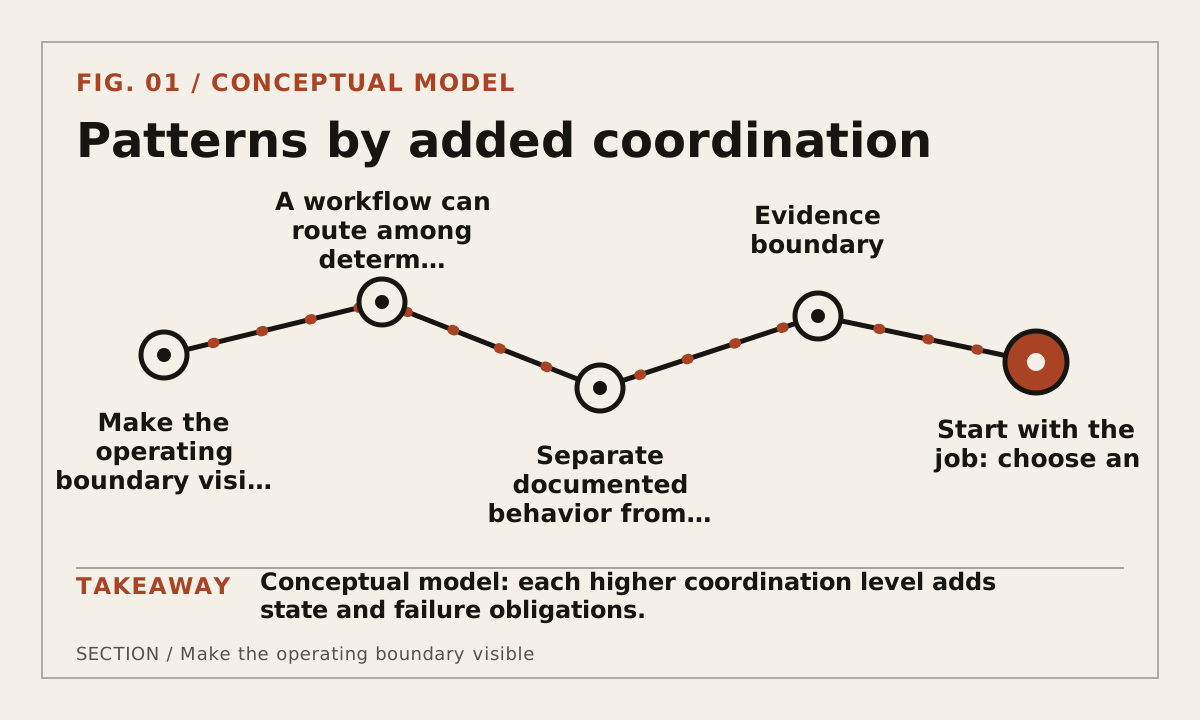
A workflow can route among deterministic steps, let one agent choose tools, delegate to specialists, coordinate several actors or pause at an approval boundary. The pattern determines where state lives and which component can end or retry work.
Patterns by added coordination
Build a reproducible path
For AI Agent Patterns That Survive Production, use a small fixture that another developer can repeat without privileged production data. Change one boundary at a time and preserve the exact configuration needed to explain how the page's decision was reached.
- Draw the task as states and observable transitions.
- Implement the single-agent or deterministic baseline first.
- Add one pattern to address a measured coordination or control need.
- Test termination, duplicate work, partial failure and intervention.
Keep secrets outside the ai agent patterns artifact. Record variable names, scopes and owners, then verify the relevant system of record whenever this tool or workflow can change external state.
Record evidence that survives a rerun
Compare patterns on the same task, dataset and acceptance criteria. Traces should reveal who held state, why a transition occurred and how the system recovered; final-answer quality alone hides orchestration defects.
- State owner and transition rule
- Tool and data boundary per actor
- Termination, retry and timeout behavior
- Human intervention and trace evidence
Date the AI Agent Patterns That Survive Production record and keep factual observations separate from inference. If a claim depends on a hosted service, preview feature or moving SDK, name that dependency beside the claim.
Use a decision rule and a stopping rule
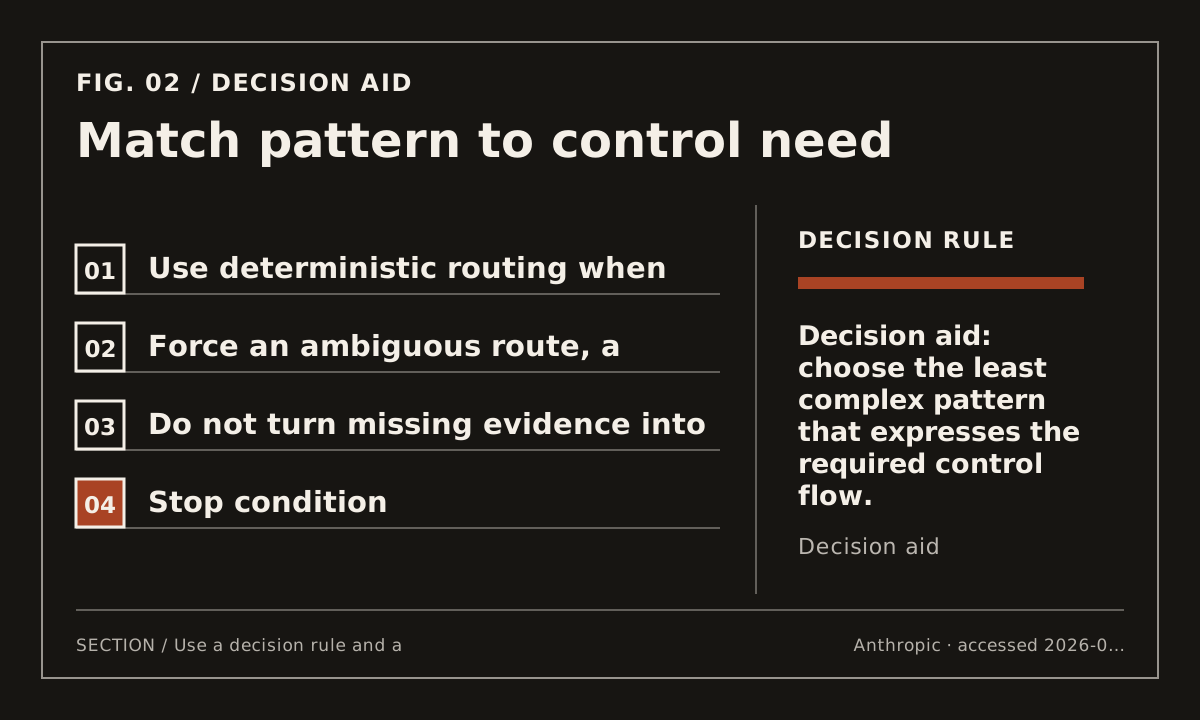
Use deterministic routing when rules are known, a single agent when one context and toolset suffice, and multi-agent coordination only when separation or parallelism produces measurable value.
Force an ambiguous route, a failed tool and a non-responsive specialist. The pattern should stop or recover predictably without repeating side effects or silently discarding state.
Match pattern to control need
Protect against predictable failure and continue deliberately
For AI Agent Patterns That Survive Production, the architecture review flags three recurring failure modes: the page becomes a vendor listicle; frameworks are compared on different tasks; deployment and observability costs are ignored. Treat them as release checks, not footnotes. This page remains draft when its exact implementation or intent evidence is still research-gated.
Use the AI agent framework field guide next: it starts selection from a fixed production job and hard requirements.
Use the multi-agent pattern guide next: it tests whether coordination earns its state and handoff costs.
Use the human-in-the-loop pattern next: it places durable review before consequential actions.
Use the framework implementation series next: it holds one fixture constant across different runtimes.