Compare tools on shared pull requests
Choose AI code review tools by running the same representative pull requests through the same decision rubric. Integration convenience matters, but it cannot substitute for measured useful findings, misses, noise, access, and maintenance cost. This page owns one search job: choose an AI code review tool using the same pull requests. It does not promise a universal product ranking, an undisclosed benchmark, or hands-on results that are not present in the evidence ledger.
Give developers a source-led, reproducible answer for how to choose an AI code review tool using the same pull requests, with explicit version and stop conditions. In practice, that means separating documented behavior from inference, naming the consequence of being wrong, and defining the evidence that would change the decision.
For the code review tools decision, the surrounding AI Code Review: A Verification-First Workflow guide defines the nearest architectural boundary and prevents this page from absorbing a broader search job.
Build a review corpus and permission ledger
The comparison artifact is a frozen PR corpus with known risks, a tool configuration manifest, permission inventory, blinded finding dispositions, and a ledger of setup and review effort. The artifact should be portable enough for another engineer to inspect without relying on a private chat transcript or the memory of the person who ran it.
For code review tools, the source ledger uses current first-party material from GitHub and CodeRabbit to define documented concepts and interfaces. Those sources do not prove performance on this site's hypothetical setup, so every comparative or operational conclusion remains tied to the recorded artifact and a local verification step.
After the code review tools evidence is recorded, use CodeRabbit Review: Setup, Test, and Limits; it covers the adjacent implementation handoff without duplicating the protocol here.
Run a matched tool trial
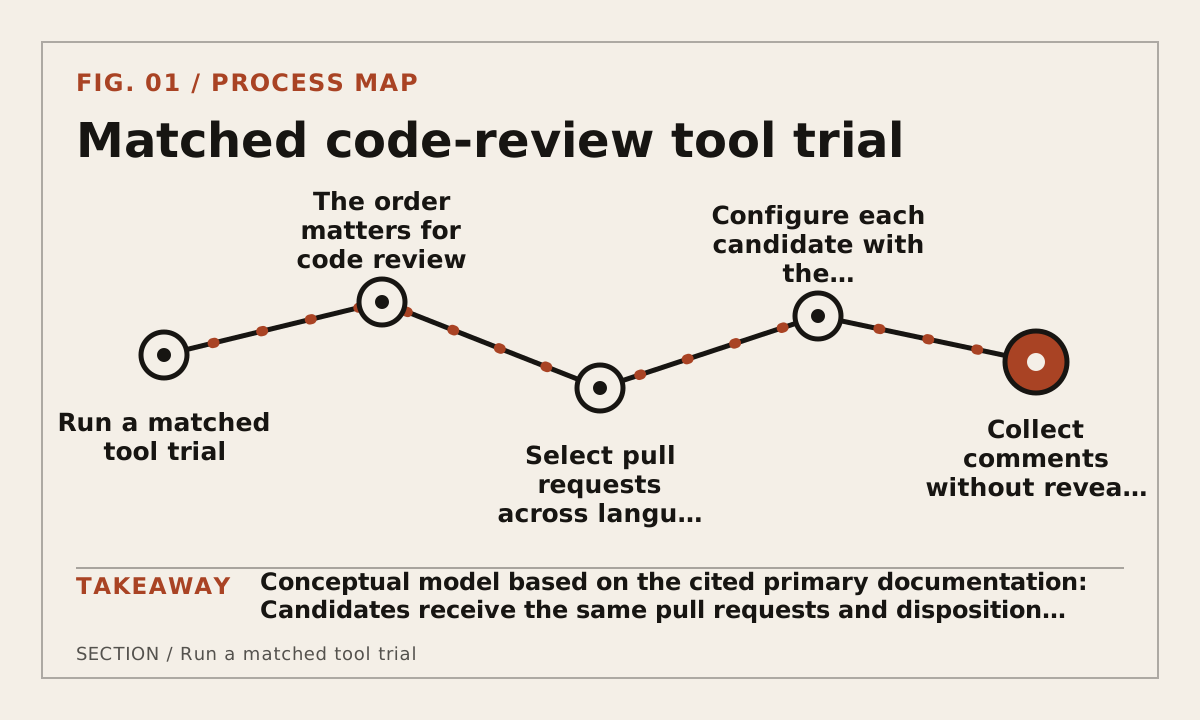
The order matters for code review tools. Starting with tooling or a score before the evidence boundary is defined makes later results hard to interpret. Keep each step small enough that its input, authority, output, and failure state can be reviewed independently.
- Select pull requests across languages, change sizes, generated files, and risk classes the team actually merges.
- Configure each candidate with the narrowest comparable repository and write permissions.
- Collect comments without revealing tool identity to the engineers who label usefulness where practical.
- Compare verified findings, material misses, false positives, latency, administration, and removal steps.
Record the exact code review tools configuration and environment beside the artifact, but do not invent a version number in evergreen copy. At execution time, pin the tested release, preserve command output or trace evidence, and stop when the next action requires new authority or an unverifiable assumption.
Matched code-review tool trial
Control corpus and configuration bias
For code review tools, the architecture flags three recurring risks for this family: vendor claims replace an independent test, false positives are not measured, and human verification is removed from the workflow. They are not abstract caveats; each can make a polished result unusable for the decision this page owns.
- A corpus made only of seeded bugs may reward pattern recognition but miss ordinary maintenance review.
- Defaults, repository indexing, and organization policy can differ enough to invalidate a superficial comparison.
- A tool may find more issues while creating enough noise that engineers stop reading its comments.
Treat a code review tools failure label as the start of investigation, not as an explanation. Preserve the case, identify which evidence or control was missing, and rerun one changed condition at a time. That discipline separates a tool limitation from a bad task definition, weak context, an unsafe permission, or a broken test harness.
Verify findings, noise, and access
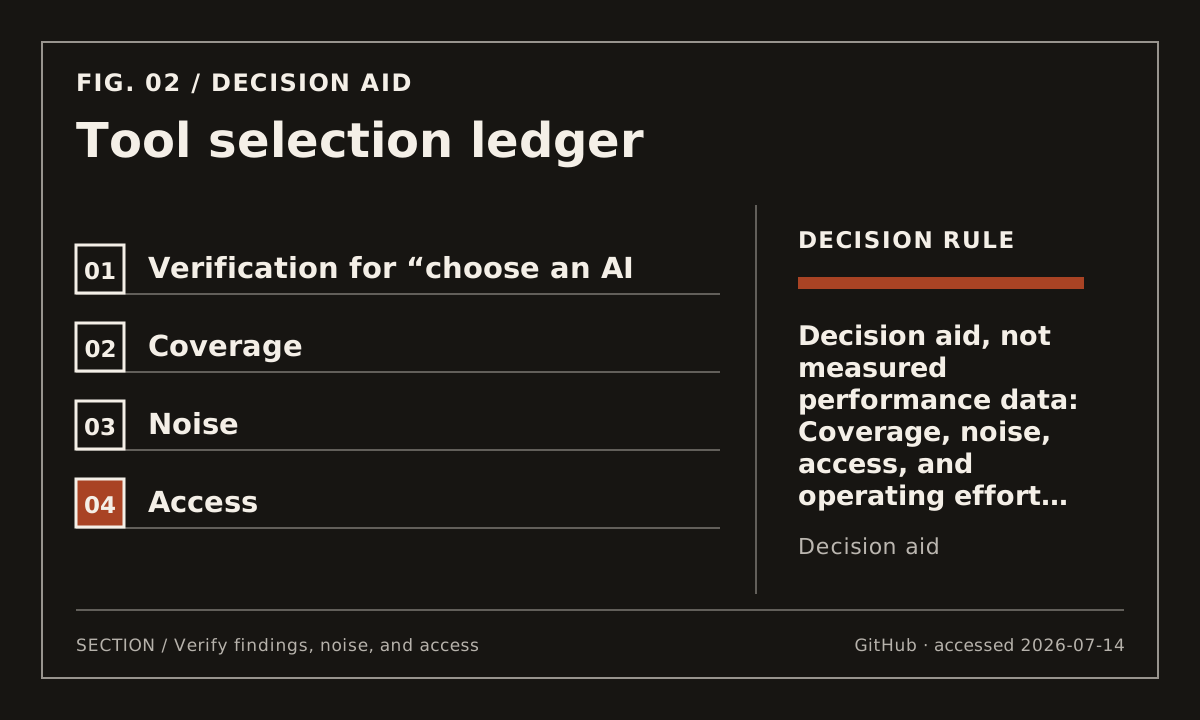
Verification for “choose an AI code review tool using the same pull requests” needs a stopping rule that another engineer can apply. The checks below favor direct artifacts and observable state over confidence, verbosity, or vendor reputation. A failed check keeps the conclusion provisional even when the generated output appears convincing.
| Check | Evidence to retain | Stop condition |
|---|---|---|
| Coverage | The same PR corpus and risk taxonomy is used | Each tool receives a different task |
| Noise | Duplicate and incorrect comments are dispositioned | Only total comment count is shown |
| Access | Permissions and retention are recorded | A broad installation is treated as free |
Run the code review tools gate against both an expected success and at least one denied, malformed, or recovery path. Store disagreements and residual risk beside the result. If the evidence cannot distinguish a system failure from an evaluation failure, improve the instrument before using its score to approve a release.
When the code review tools gate exposes a neighboring problem, continue with AI Code Checker vs Repository-Aware Review and carry this page's evidence record into that step.
Tool selection ledger
Choose a bounded pilot
Select a tool only for the repositories and risk categories represented in the trial. If evidence is mixed, retain a reversible pilot and publish the unresolved trade-off instead of naming a universal winner. This rule applies to the documented search job, not to every use of code review tools. A different repository, data boundary, model, tool set, or consequence requires a new dated check.
End the code review tools record with the owner, next review trigger, and one of four outcomes: proceed within the tested boundary, reduce scope, gather missing evidence, or reject the approach. This preserves a useful negative result and prevents scheduled editorial copy from implying an experiment that was never run.
A matched alternative to the code review tools path is documented in Claude Code Review: A Reproducible PR Workflow, which should be compared on the same artifact rather than by feature claims.