Use AI findings as hypotheses
AI code review should create specific, testable hypotheses about a change; it should not replace the engineer who owns the merge. Value comes from findings that survive inspection against code, requirements, and executable checks. This page owns one search job: use AI review without outsourcing engineering judgment. It does not promise a universal product ranking, an undisclosed benchmark, or hands-on results that are not present in the evidence ledger.
Give developers a source-led, reproducible answer for how to use AI review without outsourcing engineering judgment, with explicit version and stop conditions. In practice, that means separating documented behavior from inference, naming the consequence of being wrong, and defining the evidence that would change the decision.
For the ai code review decision, the surrounding AI Code Review Tools: A Tested Selection Guide guide defines the nearest architectural boundary and prevents this page from absorbing a broader search job.
Capture evidence and disposition
Use a review record that contains the base and head revisions, change intent, reviewer configuration, candidate finding, cited file and behavior, verification action, disposition, and final human decision. The artifact should be portable enough for another engineer to inspect without relying on a private chat transcript or the memory of the person who ran it.
For ai code review, the source ledger uses current first-party material from GitHub and CodeRabbit to define documented concepts and interfaces. Those sources do not prove performance on this site's hypothetical setup, so every comparative or operational conclusion remains tied to the recorded artifact and a local verification step.
After the ai code review evidence is recorded, use Claude Code Review: A Reproducible PR Workflow; it covers the adjacent implementation handoff without duplicating the protocol here.
Run a verification-first review
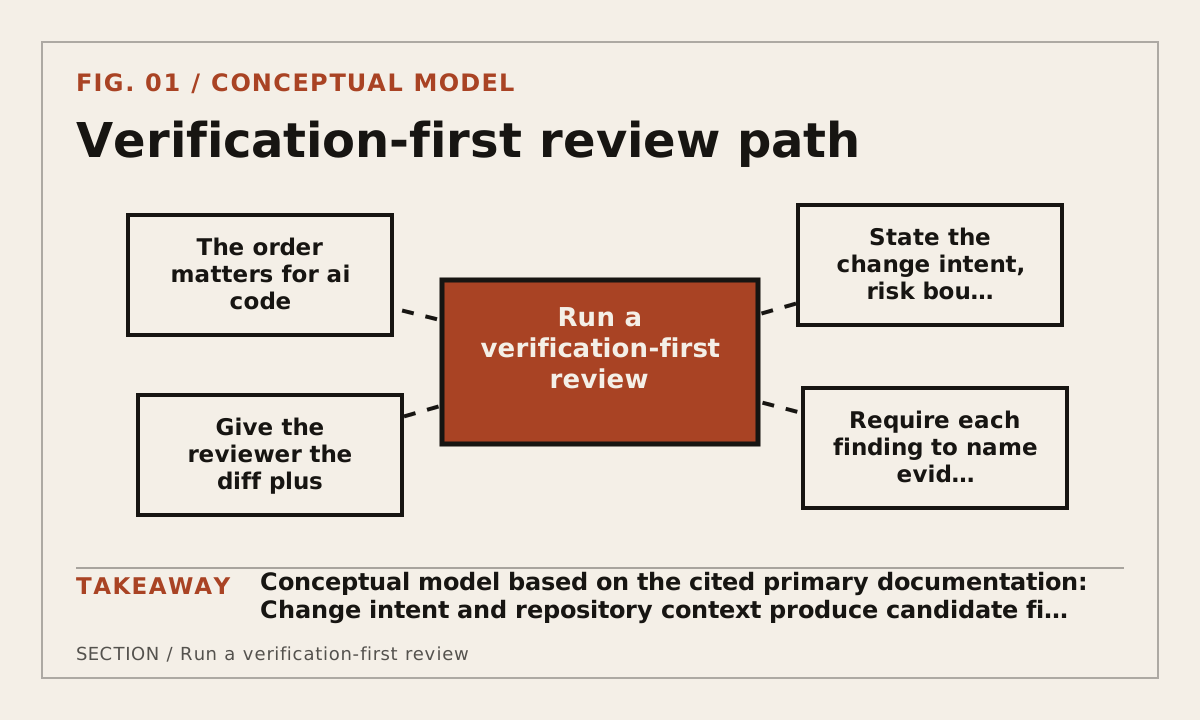
The order matters for ai code review. Starting with tooling or a score before the evidence boundary is defined makes later results hard to interpret. Keep each step small enough that its input, authority, output, and failure state can be reviewed independently.
- State the change intent, risk boundaries, and generated or sensitive files the reviewer should treat specially.
- Give the reviewer the diff plus the minimum repository context required to reason about behavior.
- Require each finding to name evidence and a consequence; verify it with code inspection or a focused check.
- Classify useful findings, misses, duplicates, and false positives before adjusting prompts or merge policy.
Record the exact ai code review configuration and environment beside the artifact, but do not invent a version number in evergreen copy. At execution time, pin the tested release, preserve command output or trace evidence, and stop when the next action requires new authority or an unverifiable assumption.
Verification-first review path
Measure noise as well as misses
For ai code review, the architecture flags three recurring risks for this family: vendor claims replace an independent test, false positives are not measured, and human verification is removed from the workflow. They are not abstract caveats; each can make a polished result unusable for the decision this page owns.
- Vendor feature lists do not establish that comments will be useful on the team's own pull requests.
- Style and low-impact suggestions can crowd out security, correctness, and migration risk.
- Treating every comment as a defect increases review load and teaches teams to ignore the channel.
Treat a ai code review failure label as the start of investigation, not as an explanation. Preserve the case, identify which evidence or control was missing, and rerun one changed condition at a time. That discipline separates a tool limitation from a bad task definition, weak context, an unsafe permission, or a broken test harness.
Check specificity, evidence, and ownership
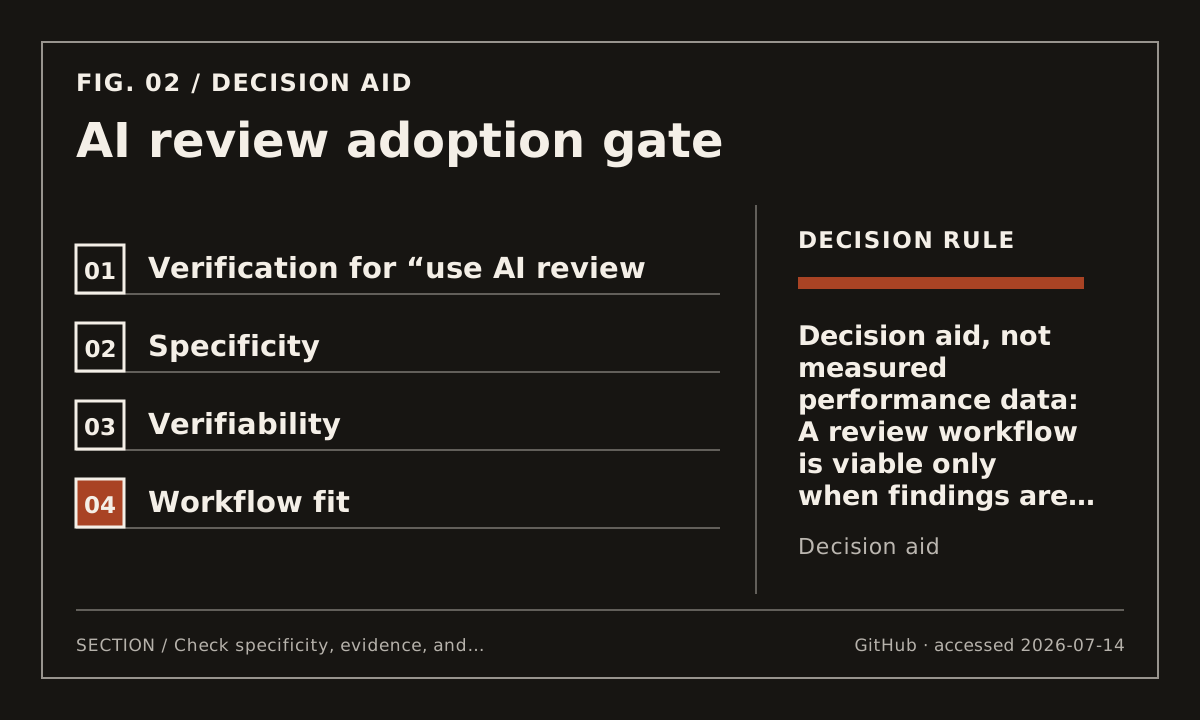
Verification for “use AI review without outsourcing engineering judgment” needs a stopping rule that another engineer can apply. The checks below favor direct artifacts and observable state over confidence, verbosity, or vendor reputation. A failed check keeps the conclusion provisional even when the generated output appears convincing.
| Check | Evidence to retain | Stop condition |
|---|---|---|
| Specificity | Finding points to a concrete path and behavior | Comment could apply to any repository |
| Verifiability | A reviewer can confirm or reject it with available evidence | Claim relies on authority or tone |
| Workflow fit | AI comments inform, but do not silently approve, the merge | Human ownership disappears |
Run the ai code review gate against both an expected success and at least one denied, malformed, or recovery path. Store disagreements and residual risk beside the result. If the evidence cannot distinguish a system failure from an evaluation failure, improve the instrument before using its score to approve a release.
When the ai code review gate exposes a neighboring problem, continue with Evaluate an AI Code Reviewer and carry this page's evidence record into that step.
AI review adoption gate
Adopt by change class, not by demo
Adopt AI review where verified useful findings exceed the correction and triage burden for the target change class. Keep a human merge owner and reassess after material model, configuration, or repository changes. This rule applies to the documented search job, not to every use of ai code review. A different repository, data boundary, model, tool set, or consequence requires a new dated check.
End the ai code review record with the owner, next review trigger, and one of four outcomes: proceed within the tested boundary, reduce scope, gather missing evidence, or reject the approach. This preserves a useful negative result and prevents scheduled editorial copy from implying an experiment that was never run.