Separate prototype speed from production fitness
Vibe coding is prompt-led software creation in which a developer accepts substantial model-generated code and steers by observed behavior. It can accelerate exploration, but production fitness still depends on understanding, verification, security, and ownership. This page owns one search job: understand where vibe coding helps and where it becomes unsafe. It does not promise a universal product ranking, an undisclosed benchmark, or hands-on results that are not present in the evidence ledger.
Give developers a source-led, reproducible answer for how to understand where vibe coding helps and where it becomes unsafe, with explicit version and stop conditions. In practice, that means separating documented behavior from inference, naming the consequence of being wrong, and defining the evidence that would change the decision.
For the vibe coding decision, the surrounding A Vibe Coding Workflow With Verification Gates guide defines the nearest architectural boundary and prevents this page from absorbing a broader search job.
Keep a dossier that survives the chat
Keep a prototype dossier with goal, disposable or durable classification, generated files, dependencies, data handled, test evidence, threat notes, unresolved assumptions, deployment boundary, and the person who can maintain or replace it. The artifact should be portable enough for another engineer to inspect without relying on a private chat transcript or the memory of the person who ran it.
For vibe coding, the source ledger uses current first-party material from Andrej Karpathy and Anthropic to define documented concepts and interfaces. Those sources do not prove performance on this site's hypothetical setup, so every comparative or operational conclusion remains tied to the recorded artifact and a local verification step.
After the vibe coding evidence is recorded, use Vibe Coding Risks: Security, Maintenance, and Ownership; it covers the adjacent implementation handoff without duplicating the protocol here.
Generate narrowly and verify continuously
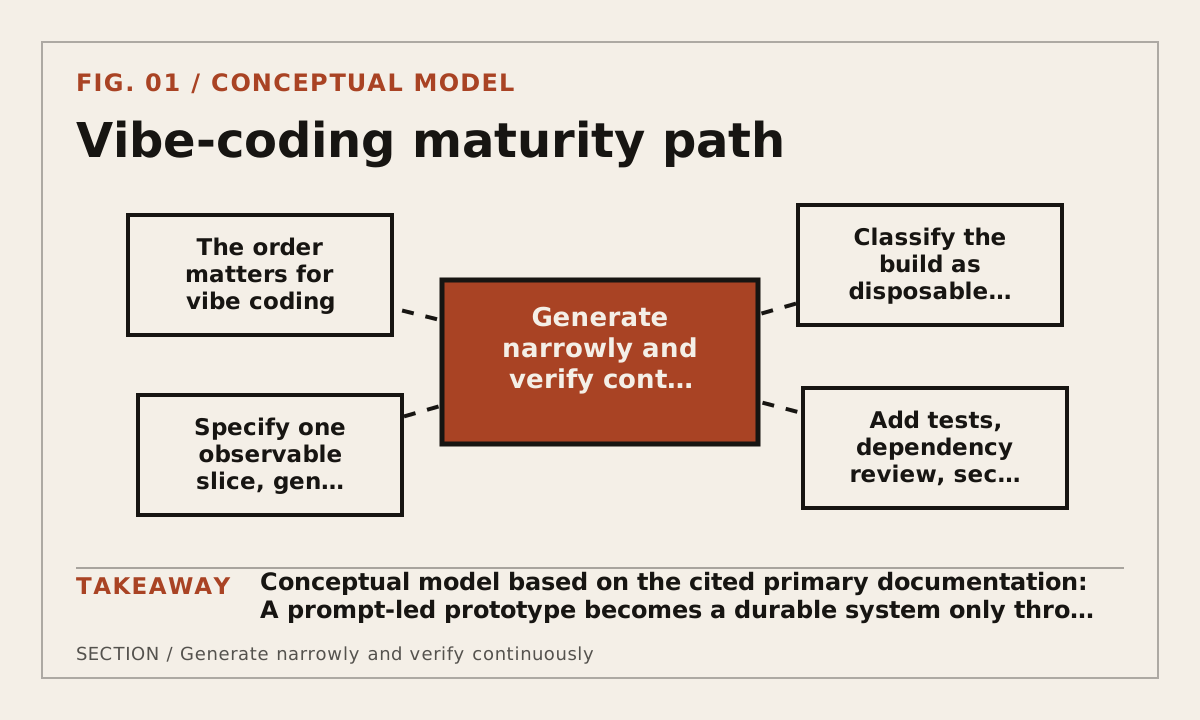
The order matters for vibe coding. Starting with tooling or a score before the evidence boundary is defined makes later results hard to interpret. Keep each step small enough that its input, authority, output, and failure state can be reviewed independently.
- Classify the build as disposable exploration, internal prototype, or candidate production system before granting tools or data.
- Specify one observable slice, generate in small increments, and inspect the diff and runtime after each step.
- Add tests, dependency review, secret controls, accessibility, and failure handling before exposing real users or data.
- Require an owner to explain architecture, reproduce the build, update dependencies, and recover from failure.
Record the exact vibe coding configuration and environment beside the artifact, but do not invent a version number in evergreen copy. At execution time, pin the tested release, preserve command output or trace evidence, and stop when the next action requires new authority or an unverifiable assumption.
Vibe-coding maturity path
Expose hidden ownership debt
For vibe coding, the architecture flags three recurring risks for this family: prototype speed is confused with production readiness, security and maintenance debt are hidden, and the author cannot verify or own the generated system. They are not abstract caveats; each can make a polished result unusable for the decision this page owns.
- Fast iteration can hide architecture and dependency decisions that become expensive once users and data arrive.
- Generated code may include insecure defaults or copied assumptions the author cannot recognize during review.
- A project without a maintainer who understands its state and failure modes is not production-ready, even when it works today.
Treat a vibe coding failure label as the start of investigation, not as an explanation. Preserve the case, identify which evidence or control was missing, and rerun one changed condition at a time. That discipline separates a tool limitation from a bad task definition, weak context, an unsafe permission, or a broken test harness.
Check fit, evidence, and maintainability
Verification for “understand where vibe coding helps and where it becomes unsafe” needs a stopping rule that another engineer can apply. The checks below favor direct artifacts and observable state over confidence, verbosity, or vendor reputation. A failed check keeps the conclusion provisional even when the generated output appears convincing.
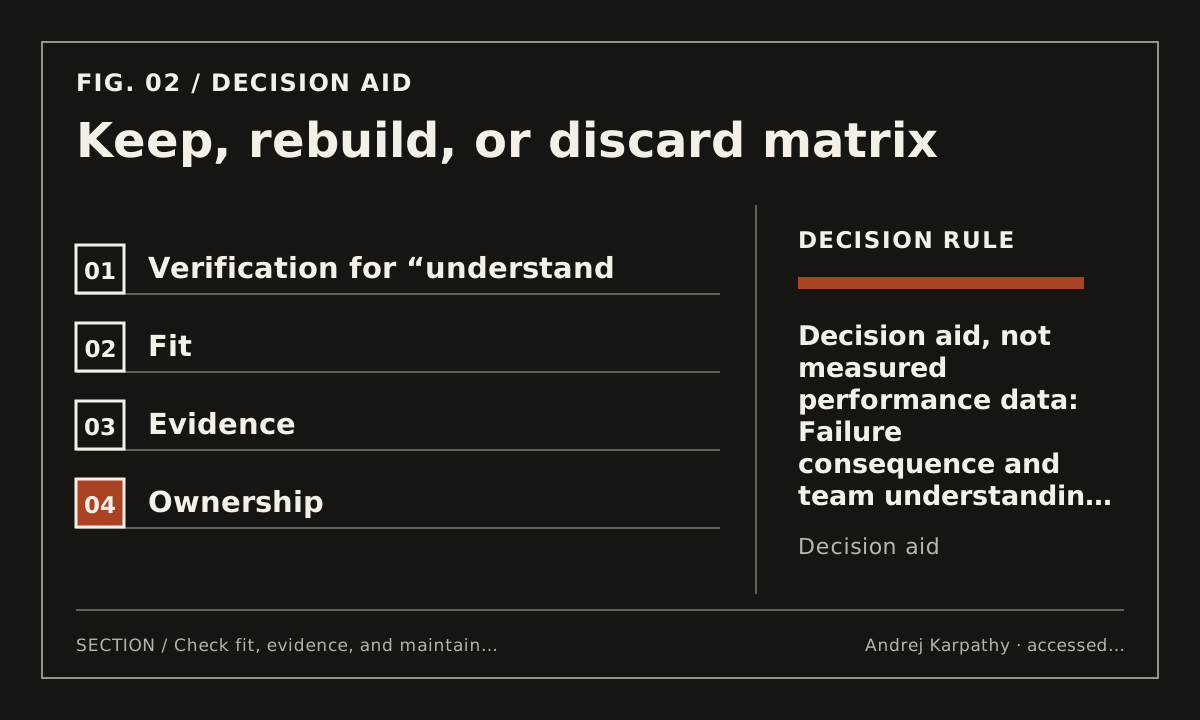
| Check | Evidence to retain | Stop condition |
|---|---|---|
| Fit | Speed is valuable and failure consequence is bounded | A prototype handles critical data by default |
| Evidence | Behavior, tests, and dependencies are inspectable | A successful demo is the acceptance test |
| Ownership | Someone can maintain, secure, and remove the system | Only the chat history explains the code |
Run the vibe coding gate against both an expected success and at least one denied, malformed, or recovery path. Store disagreements and residual risk beside the result. If the evidence cannot distinguish a system failure from an evaluation failure, improve the instrument before using its score to approve a release.
Keep, rebuild, or discard matrix
Cross a separate production gate
Use vibe coding for bounded learning and prototypes when failure is cheap and the artifact remains inspectable. Before durability or real data, cross a separate engineering gate for tests, security, accessibility, operations, and ownership. This rule applies to the documented search job, not to every use of vibe coding. A different repository, data boundary, model, tool set, or consequence requires a new dated check.
End the vibe coding record with the owner, next review trigger, and one of four outcomes: proceed within the tested boundary, reduce scope, gather missing evidence, or reject the approach. This preserves a useful negative result and prevents scheduled editorial copy from implying an experiment that was never run.